50,000 colliding GPU cubes at 119 FPS on an RTX 3060.
RustingEngine is a game engine written in Rust, made for big physics scenes: thousands of falling, flying and colliding objects that would make most engines give up long before your graphics card is even busy.
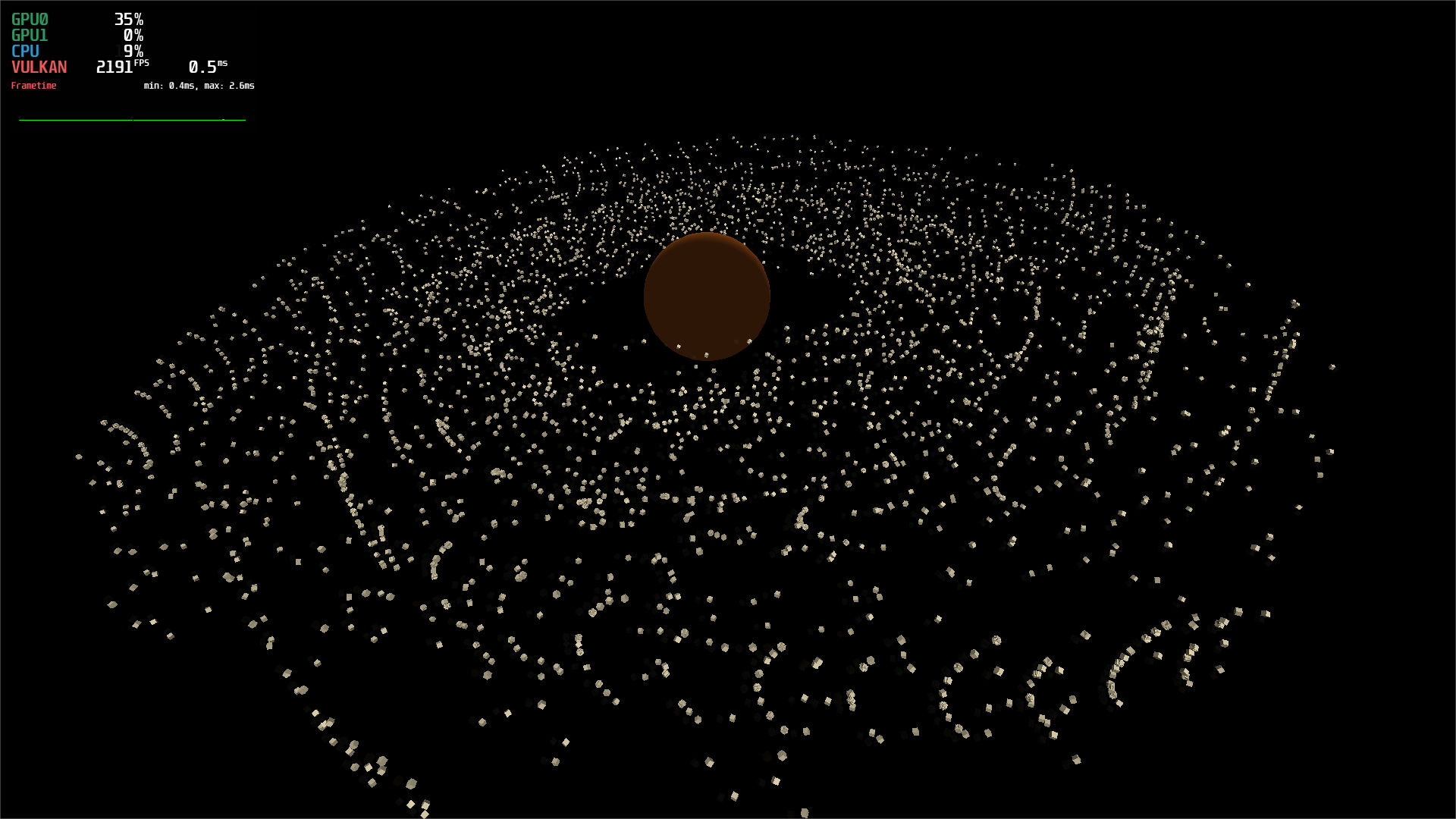
One planet, 10,000 moving cubes, 2,191 FPS at 1920×1080 on an RTX 3060 and a Ryzen 5 7600X. The GPU was only 35% busy. This is a stress scene made to show what the engine can do, not a promise that every game runs this fast.
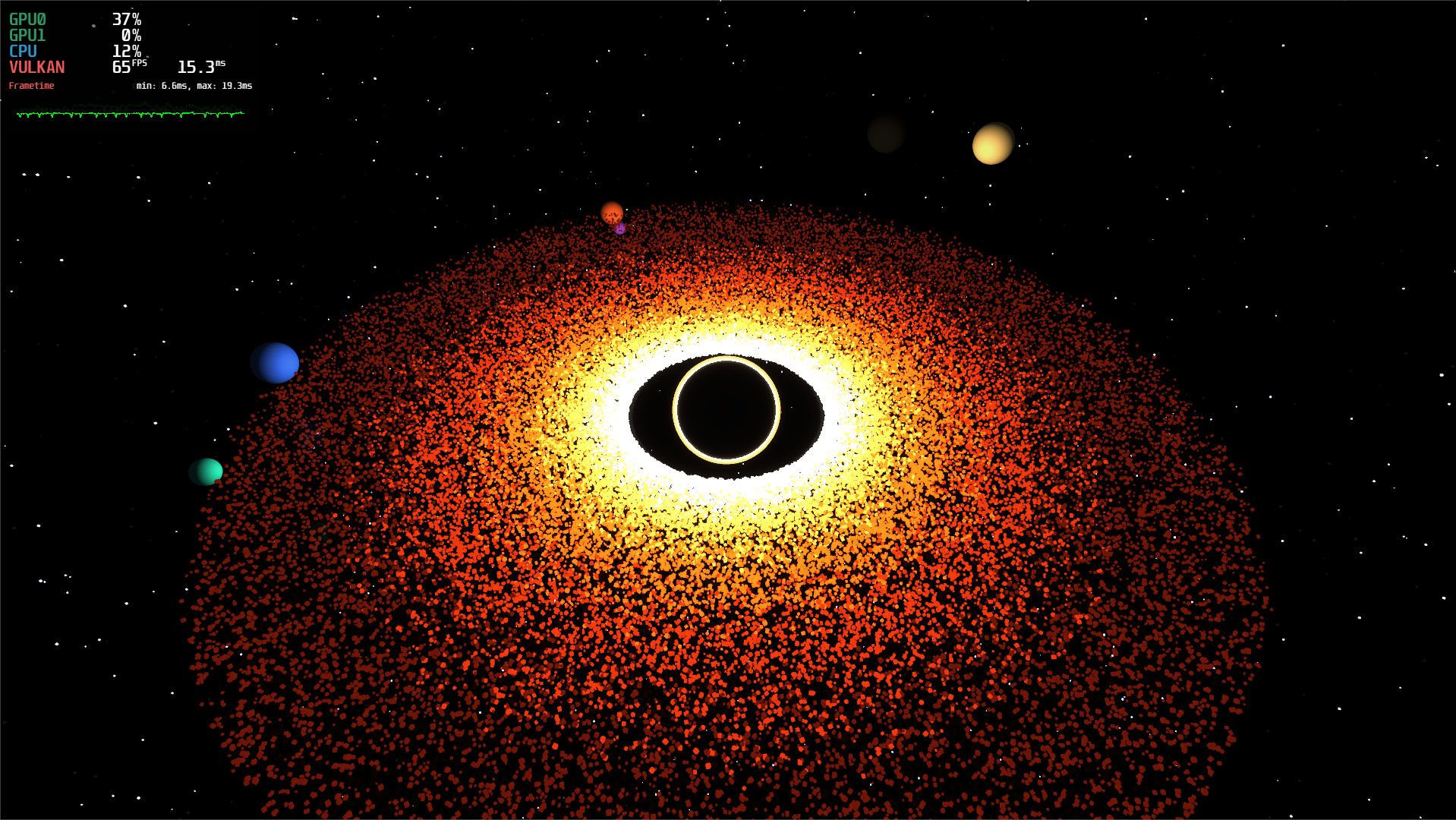
A black hole with a 60,000-particle accretion disk and five planets spiraling in, at 65 FPS on the same machine. Every particle is a GPU body; one condition shader of about 25 lines of GLSL adds the gravity and swallows the planets.
The idea
Most engines move every object on the CPU. That is fine for a few hundred objects and painful for ten thousand. RustingEngine lets you choose: objects your game needs to touch every frame stay on the CPU, and the crowd of debris, particles and swarms lives on the GPU. The engine only tells your game what matters, like “something entered this area”, instead of copying every object back each frame.
What you get
- An editor in the style of Blender and Godot. Split and resize panels, drag in models and images, paint tile levels, preview the game without building it.
- Real physics. Stacks, rolling balls, ragdoll-like chains, hinges, springs, joints that break, water you can float in.
- Good looking scenes. Shadows, glass, reflections, fog, bloom and soft shadows in corners.
- Plain Rust for game code. Simple calls like “move this”, “is that key held”, “what did I hit”. Use any Rust library you like.
- Same result every time. Record a play session and replay it exactly. Great for finding bugs that only happen once.
- Games you can ship. Export a ready-to-run game for Linux or Windows.
Made for AI agents too
Every game in samples/ was built by an AI agent using only the engine’s
command-line tool, without opening the editor. The agent creates the project,
edits the scene, writes the code, plays the game in tests and looks at
screenshots to check its own work. New projects come with a guide that
teaches any agent how to do the same.
Sample games
| Game | What it is |
|---|---|
sky_hop | 2D platformer with moving lifts and coins |
brick_bounce | Classic brick breaker |
snake_trail | Snake on a tile map |
crate_keeper | Crate-pushing puzzle |
lantern_grid | Lights-out puzzle played with the mouse |
putt_course | Mini golf with a rolling ball |
core_defense | Top-down turret shooter |
target_range | First-person shooting gallery |
tower_topple | Knock block towers down with thrown balls |
hammer_run | Third-person obstacle course |
night_vault | Stealth game with patrolling guards |
ember_arena | Third-person arena survival |
forever_bear_booth | Horror night shift with CCTV monitors |
Quick start
You need Rust and a graphics card with Vulkan. Linux and Windows are supported.
git clone https://github.com/RustingStudio/RustingEngine.git
cd RustingEngine
./scripts/run_editor.sh
Play a sample game:
cargo run --release --bin rusting -- run samples/sky_hopSee the 10,000 cubes for yourself:
cd testGame
cargo run --release
Or the black hole, and 50,000 colliding cubes:
cargo run --release --features window --example black_hole
cargo run --release --features window --example physics_bench -- falling 50000
New here? Start with Getting started and the tutorials. See the changelog for what is new and the roadmap for what comes next.
Contributing
Bug reports, profiling results, documentation fixes, and focused pull requests are welcome. Please read CONTRIBUTING.md before opening a PR. Performance changes should include the scene, hardware, resolution, build mode, and before/after measurements so results can be reproduced.
License
RustingEngine uses the Rusting Engine License 1.0. Games and other created works may be commercial. Redistribution of the engine is subject to the license terms and attribution requirements.